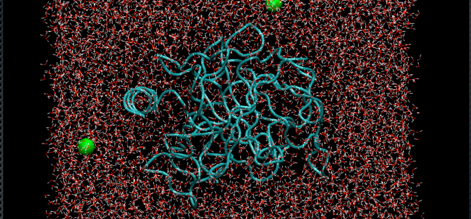
Molecular simulation is an important technique to analyze and interpret molecular phenomena across many disciplines. Small-angle scattering (SAS) utilizing either X-ray or neutron sources is a valuable method to characterize shape, interactions, and properties of many soft-matter systems. Modeling of SAS data is typically done using analytical functions and/or dummy-ball (DB) models. While these methods are simple, they have proven to be quite robust and have allowed for a tremendous expansion of SAS studies to a wide variety of systems. Atomistic modeling can be used to interpret SAS data and inherently provides structural and physical knowledge that are unavailable using analytical or DB models. In additional, atomistic models can allow the use of experimental and computational constraints on the SAS data.
The goal of this three day introductory course is to use modern simulation methods and software tools to predict and analyze small-angle scattering data of soft-matter systems, focussing particularly on biological systems. Participants will be familiarized with SASSIE, a software framework designed to facility the use of atomistic modeling to interpret scattering data. SASSIE-web, a product of the CCP-SAS consortium, will be the primary tool used during the course and will be freely available to the community after the course.
The course will involve a mixture of lectures and examples with student lessons. Examples will involve various protein, dna, and their complexes. The emphasis will be on structure building, ensemble molecular simulation, calculation of scattering profiles and comparison to experimental data.
Day 1: Introduction to molecular modeling using force-fields and SASSIE
Day 2: Intermediate MD, SASSIE and student projects.
Day 3: Advanced SASSIE and student projects.
Students are encouraged to contact the course organizers in advance to discuss their systems as a portion of the course will involve helping students set-up and model their project.
| Time | Lead | Activity | File |
|---|---|---|---|
| 9:00 - 9:30 AM | JEC | Course Introduction | lecture_0.pdf |
| 9:30 - 10:30 AM | JEC | Lecture 1: Coordinates to Structure | lecture_1.pdf |
| 10:30 - 10:45 AM | Break | ||
| 10:45 - Noon | DWW/JEC/EHB | Lab 0: Software Installation & SASSIE-web | lab_0.pdf |
| Noon - 1:00 PM | Lunch | ||
| 1:00 - 2:45 PM | DWW/HZ/EHB | Lab I: VMD and PDB Scan | lab_I.pdf |
| 2:45 - 3:00 PM | Break | ||
| 3:00 - 5:00 PM | DWW/HZ/EHB | Lab II: PSFGEN/NAMD | lab_II.pdf |
| Time | Lead | Activity | File |
|---|---|---|---|
| 9:00 - 10:00 AM | JEC | Lecture 2: MD II | lecture_2.pdf |
| 10:00 - 10:15 AM | Break | ||
| 10:15 - Noon | DWW/HZ/EHB | Lab III: NAMD | lab_III.pdf |
| Noon - 1:00 PM | Lunch | ||
| 1:00 - 1:30 PM | JEC | Lecture 3: MMC & SASSIE Overview | lecture_3.pdf |
| 1:30 - 3:00 PM | DWW/HZ/EHB | Lab IV: SASSIE-web Quick Start | lab_IV.pdf |
| 3:00 - 3:15 PM | Break | ||
| 3:00 - 4:00 PM | DWW/HZ/EHB | Lab V: SASSIE-web Analysis | lab_V.pdf |
| 4:00 - 5:00 PM | ALL | Breakout sessions for student projects | - |
| Time | Lead | Activity | File |
|---|---|---|---|
| 9:00 - 10:15 AM | DWW/HZ | Lab VI: Advanced SASSIE-web | lab_VI.pdf |
| 10:15 - 10:30 AM | Break | ||
| 10:30 - 10:45 AM | JEC | Lecture 4: Advanced Building | lecture_4.pdf |
| 10:30 - Noon | DWW | Lab VII: Advanced Building | lab_VII.pdf |
| Noon - 1:00 PM | Lunch | ||
| 1:00 - 2:45 PM | ALL | Lab VIII: Breakout sessions for student projects | - |
| 2:45 - 3:00 PM | Break | ||
| 3:00 - 5:00 PM | ALL | Lab IX: Breakout sessions for student projects | - |